Sample record
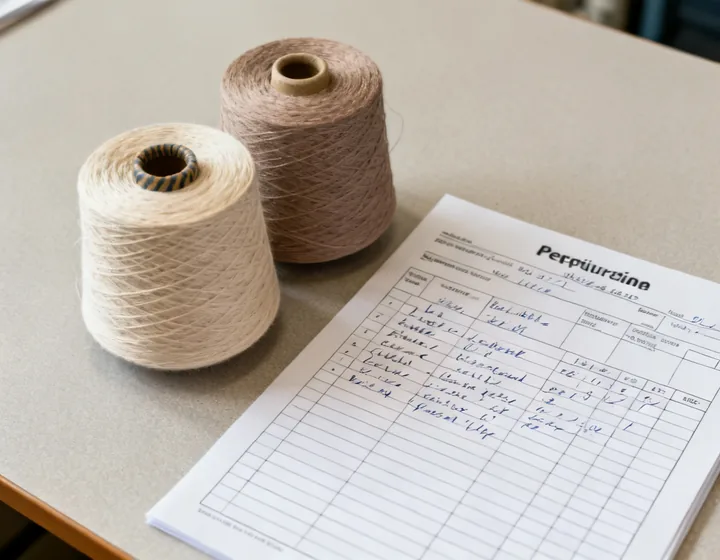
Bind each cone, fiber lot or fabric cutting to mill name, article code, date and reviewer. A method title such as colorfastness or tensile strength is not a result until edition, conditioning and specimen are named.
FREE sourcing support and up to 3% coordination support for qualified briefs. Eligibility applies to qualified business buyers and is confirmed after we review your product, quantity, destination, and sourcing requirements.
Independent sourcing partner
LoomHaven Procurement helps US buyers turn a dupont search into a comparable mill request for yarns, fibers and threads. The reference brand names a starting point; it is not our identity, inventory or authorization.
A dupont label on a search page does not tell a mill which linear density, twist, luster or dye lot you will accept. Record the requested value, tolerance and test basis, or leave the field open for exact-item confirmation. Price comparison starts only after composition, count system, package form, lot size, sampling charges and US destination share one written basis.
| Input | Supplier response |
|---|---|
| Fiber composition and count system | Confirm deviations against the retained cone or fiber sample |
| Ply, twist, luster and package form | State what is included in the quoted article |
| Lot size and destination | Separate freight, duties and sampling from yarn price |
A stock cone can screen hand and construction. A lab dip addresses color. A pre-production lot addresses process settings. None of those automatically represents the bulk dye lot. Record sample identity, date, reviewer and permitted deviation before moving to the next handoff.
| Stage | Record | Owner |
|---|---|---|
| Clarify the brief | Count, ply, package and end use | Buyer, in writing |
| Compare mills | Article-specific answers on one sheet | Sourcing coordinator |
| Approve the sample | Retained cone or fiber with decision | Buyer technologist |
| Agree bulk checks | Method, specimen and lot rules | Buyer and mill, per order |
Inquiry families on this site are generic configurations for Yarns, Fibers and Threads plus related protective textiles. They are not dupont stock-keeping units and do not prove equivalence.
Open inquiry configurations when you are ready to name the family, then send quantity and destination.
Bind each cone, fiber lot or fabric cutting to mill name, article code, date and reviewer. A method title such as colorfastness or tensile strength is not a result until edition, conditioning and specimen are named.
Ask for a current technical sheet tied to the quoted yarn. Certificates remain mill documents. LoomHaven Procurement does not present them as site-owned credentials.
Apparel sewing thread, industrial stitching, reinforcement and protective textile converting each change abrasion, heat, moisture and shade-lot rules. State the finished product before asking mills to guess.
| Use | Requirement to clarify |
|---|---|
| Apparel or sewing programs | Count, ply, lubrication and shade-lot policy |
| Industrial converting | Linear density, package form and lot size |
| Protective textile programs | Fiber family, test method and acceptance basis |
Share open specifications, quantity and destination so mill offers can be compared on the same basis.
Request factory quotesQualified business buyers may receive FREE matching and initial quote support, with up to 3% coordination support after the brief is reviewed. Eligibility applies to qualified business buyers and is confirmed after we review your product, quantity, destination, and sourcing requirements.
This is not a fixed-discount offer, a floor-price claim, or a time-limited offer.